๐ŸŒฟ Natural Psychotherapy

Prof. Zhang Xiangyang ยท Tsinghua University

A Chair Professor at Tsinghua University's Department of Psychology and Cognitive Science, Chief Scientist of the CAS Mental Health Service System. Ph.D. in Psychopharmacology from Peking University, postdoc at Yale School of Medicine. Previously tenured Associate Professor and Chief Psychiatrist at Baylor College of Medicine and UT Medical School. Published 750+ SCI papers, H-index 77, recognized as Highly Cited Researcher for 6 consecutive years and among the top 2% of scientists worldwide.

His Natural Psychotherapy, rooted in Morita Therapy and integrated with traditional Chinese culture and Buddhist wisdom, is built on the core principle of "Accept pain, take positive action." It effectively treats OCD, anxiety, phobias, depression, insomnia, internet addiction, and more. Group therapy can treat 40-50 OCD patients at once, with a 90% effectiveness rate โ€” all without medication.

๐Ÿ›๏ธ Tsinghua Psychology Centennial ๐Ÿง  Natural Psychotherapy ๐ŸŒ International Outreach ๐Ÿ“Š 800+ SCI Papers ๐Ÿง˜ Group Therapy Pioneer
Lecture 1

๐Ÿง  Psychological Distress vs. Mental Illness

๐Ÿ“… 2026.5.21โฑ 2h2min
Content: Rapid identification of mental illness vs. psychological distress ยท 6 major mental illnesses ยท Data on anxiety, depression, OCD ยท Adolescent psychological issues ยท Real-life cases (nail biting, candy craving, unusual hairstyles)

๐Ÿง  Natural Psychotherapy Lecture 1: Psychological Distress vs. Mental Illness โ€” How to Distinguish

Speaker: Professor Zhang Xiangyang (Xinghua Chair Professor, Department of Psychology and Cognitive Science, Tsinghua University) Lecture Theme: Mental Health Science Popularization ยท Theory and Practice of Natural Psychotherapy Date: May 21, 2026 Duration: ~2 hours


๐Ÿซ Opening: Remarks by Secretary Li Ying

  • 2026 marks the centennial of psychology at Tsinghua (the Psychology Department was established in 1926)
  • In 2024, the Department of Psychology and Cognitive Science was formed (restructured from the former Department of Psychology)
  • The university is advancing the “Healthy China” strategy, with mental health as a key priority
  • This course is hosted by the university labor union’s “Faculty Mental Health Education Promotion Association” platform
  • Goal: Cultivate a core team of campus public-interest mental health volunteers
  • Hope for everyone: โ‘  Persist in theoretical study โ‘ก Practice actively โ‘ข Grow together

๐Ÿ‘จโ€๐Ÿซ Professor Zhang’s Self-Introduction

“Back in the day, I desperately wanted to get into Tsinghua University, but I just couldn’t make it, so I went to Anhui Medical University instead. But who would’ve thought โ€” after all those twists and turns, I still couldn’t get into Tsinghua as a student, so I figured I’d just come here and be a professor instead.” ๐Ÿ˜„

  • Education: Graduated from Anhui Medical University in 1989 โ†’ M.S. and Ph.D. in Psychopharmacology at Peking University
  • Overseas Experience: Postdoctoral Fellow and Associate Research Scientist at Yale School of Medicine โ†’ Assistant Professor at Baylor College of Medicine โ†’ Tenured Associate Professor / Attending Psychiatrist at University of Texas Medical School
  • Current: Xinghua Chair Professor at Tsinghua Department of Psychology, Chief Scientist of the Mental Health Service System at the Chinese Academy of Sciences
  • Founded: Natural Psychotherapy (an indigenous psychotherapy rooted in traditional Chinese culture)

๐ŸŽฏ The Origin of Natural Psychotherapy

  • The popular psychotherapy schools in China today: Psychoanalysis, CBT, Humanistic, Family Therapy, etc. โ€” all come from the West
  • Very few psychotherapy schools have been independently founded by Chinese practitioners
  • While working as a psychiatrist at Huilongguan Hospital, Professor Zhang’s mentor, former director Zhao Shangyi, told him:

    “Every psychiatric patient’s medical history is a story written in blood and tears.”

  • This moved him deeply, and he resolved to use his knowledge to save more people suffering from mental/psychological disorders
  • Natural Psychotherapy was developed through practice โ€” practice came first, theory followed
  • The opposite of traditional therapy’s “learn theory first โ†’ supervised practice โ†’ apply”
  • Its hallmark is the greatest truths are the simplest โ€” easy to understand, learn, and apply

๐Ÿ“‹ Psychoeducation: Why Seeing a Psychologist โ‰  “Being Crazy”

Example: An American psychology professor asked a Chinese university audience during a lecture:

“A girl is on a date with a guy. The guy shows up late and says, ‘I went to see a psychologist.’ What would a Chinese girl think?”

The Chinese girl’s reaction: “You’re crazy!” and then she storms off ๐Ÿ˜…

This illustrates: 1. Chinese people have a very heavy stigma โ€” they conflate psychological distress with severe mental illness 2. Seeing a psychologist is wrongly seen as something only “crazy people” do 3. There is an urgent need for widespread mental health education

๐Ÿ’ก Professor Zhang emphasizes: Seeing a psychologist should be as normal as seeing a doctor for a cold or fever. Life cannot always be smooth sailing โ€” when you hit setbacks and feel down, anxious, or can’t sleep โ€” that itself is a psychological issue, just as deserving of professional help as any physical illness.


๐Ÿ”ฌ Core Tool: Rapidly Distinguishing Psychological Distress from Mental Illness

This is the most important content of this lecture. Professor Zhang provides a simple yet highly effective method for differentiation.

Two Core Questions + One Scoring Scale

Key Indicator: Insight (awareness of one’s own condition)

Method: Ask the patient two questions and have them rate themselves (0-100 points)

Score Range Judgment Explanation
Below 40 ๐Ÿฅ Mental Illness Denies being ill โ†’ “I’m not sick, why would I need treatment?” โ†’ Refer to psychiatry
40 and above ๐Ÿ›‹๏ธ Psychological Distress Strong desire for treatment, actively wants to solve the problem โ†’ Can receive psychotherapy

Professor Zhang’s experience: Using this method, 80-90% of cases can be correctly and quickly identified.

The Six Major Mental Illnesses (Enter the national management system, affect schooling and employment)

  1. ๐Ÿงฉ Schizophrenia โ€” commonly known as “madness,” the most typical severe mental illness
  2. ๐Ÿ”„ Bipolar Disorder โ€” emotions swing violently between mania and depression
  3. โš ๏ธ Major Depressive Disorder โ€” carries suicide risk (detailed below)
  4. ๐Ÿง’ Developmental Disorders โ€” Autism Spectrum Disorder, ADHD
  5. ๐Ÿ‘ค Personality Disorders โ€” chronically stable patterns of abnormal behavior
  6. ๐Ÿ“‰ Intellectual Disability โ€” delayed intellectual development

Scope of Psychological Disorders (No medication needed, treatable with psychotherapy)

Common Psychological Disorders Characteristics
๐Ÿ˜ฐ Anxiety Disorders Restlessness, palpitations, inability to sit still
๐Ÿ˜” Depression (Mild to Moderate) Low mood, loss of interest, anhedonia
๐Ÿ”„ Obsessive-Compulsive Disorder (OCD) Recurrent obsessive thoughts/behaviors, known as the “cancer of psychological disorders”
๐Ÿ˜จ Phobias Excessive fear of specific objects/situations
๐ŸŒ™ Insomnia Disorder A typical psychological disorder, not purely physiological
๐Ÿ“ฑ Internet/Smartphone Addiction Increasingly common among adolescents
๐Ÿ  School Refusal / Academic Disengagement Many children have reversed day-night cycles, rarely leave home
๐Ÿ’” Post-Traumatic Stress Disorder (PTSD) Stress reaction following major trauma
๐Ÿฝ๏ธ Eating Disorders Anorexia Nervosa, Bulimia Nervosa
๐Ÿฉน Non-Suicidal Self-Injury (Self-Harm) Common in adolescents, a signal of psychological distress

โš ๏ธ Special Topic: Depression (The Most Complex Case)

The Three Core Symptoms of Depression (Diagnostic Criteria)

  1. ๐Ÿ“‰ Depressed Mood โ€” persistently low mood
  2. ๐Ÿ”’ Loss of Interest/Motivation โ€” no interest in anything
  3. ๐Ÿ’” Anhedonia โ€” inability to feel pleasure

Depression Data in China

Indicator Data
Lifetime prevalence 6.8%
Total affected population Nearly 100 million people
Female vs. Male 1.5-2x
Treatment rate Less than 10% (over 90% suffer in silence)

Trend Toward Younger Ages

  • Depression cases already present in elementary school
  • Elementary school prevalence: ~10%
  • Middle school prevalence: ~10-20%
  • High school prevalence: ~20-30%
  • Senior year of high school: 40-50% show depressive symptoms
  • Left-behind children (whose parents work away from home) are a high-risk group

โšก Key Distinction: Mild-Moderate vs. Severe Depression

Type Features Treatment Approach
Mild-Moderate ๐Ÿ˜ข Experiences pain/suffering, strong desire for help Can receive psychotherapy
Severe ๐Ÿ•ณ๏ธ Not pain, but despair โ€” life holds no meaning โŒ Therapist cannot take this on! โ†’ Immediately refer to a psychiatrist for medication

โš ๏ธ Warning: Patients with severe depression do not feel “pain” โ€” they feel “despair.” Celebrities like Leslie Cheung and Coco Lee, who appeared to have everything, committed suicide because during a severe depressive episode, life feels utterly meaningless.

The antidepressant blank-period risk: It takes 2-4 weeks for medication to start working. This blank period carries the highest suicide risk.


๐Ÿ“Š Common Psychological Disorders โ€” Data at a Glance

Anxiety Disorders

  • Lifetime prevalence: 7.6%
  • Twice as common in women as in men
  • Two peak periods: 15-25 years old (adolescence) and 45-55 years old (perimenopause)
  • Approximately 22.3% of adolescents have anxiety symptoms (not necessarily an anxiety disorder)

Obsessive-Compulsive Disorder (OCD)

  • Worldwide: 2-3%, China: 2.6%
  • China has 33 million OCD patients
  • Known as the “cancer of psychological disorders” โ€” even experts are reluctant to take it on
  • Patients tend to be highly intelligent and logical
  • They often know more about OCD than their doctors
  • Hard to treat, and even harder to argue with
  • โญ Natural Psychotherapy’s breakthrough: Can treat OCD in a group setting โ€” 50 patients at a time
  • OCD treatment effectiveness 90%, clinical recovery rate 75%
  • The entire treatment process uses no medication

Sleep Disorders

  • Approximately 15% of China’s population has sleep problems
  • More common among highly educated populations (though research shows the opposite โ€” low-income, low-education groups are actually the hardest hit)
  • Insomnia is a typical psychological disorder

PTSD (Post-Traumatic Stress Disorder)

  • Commonly seen after war, earthquakes, major accidents
  • Chinese cases: Tangshan Earthquake, Wenchuan Earthquake
  • Also common after individual trauma like burns, car accidents

๐Ÿก Real-Life Cases: How Natural Psychotherapy Handles Parent-Child Relationships

Case 1: A 3.5-Year-Old Daughter Bites Her Nails (to the point of bleeding)

The parents’ attempts (all ineffective): 1. Scolding โŒ 2. Hitting โŒ 3. Applying chili water โŒ 4. Applying bitter liquid โŒ 5. Wearing rubber finger cots + chili water + bitter liquid โŒ

๐Ÿค” Think about it: According to Natural Psychotherapy principles, what should be done? (Answer to be revealed in tomorrow’s discussion)

Case 2: A 3.5-Year-Old Daughter Loves Eating Candy and Chocolate

The mother’s dilemma: - She knows sugar is bad for teeth and brain development - Her daughter cries and refuses to leave the store - The mother uses “gentle firmness” โ€” a gentle attitude but stands her ground

Professor Zhang’s commentary: ๐Ÿ’ก

“Gentle firmness may seem to resolve the immediate dilemma, but it nurtures a much bigger crisis.”

“Gentle firmness is still rejection. Repeated rejections are like taking a small hammer and tapping a big pane of glass โ€” one tap leaves no mark, but tap it over and over, and the glass will come crashing down. By early adolescence, the child will gradually shut down communication channels with their parents.”

Natural Psychotherapy principle: When handling relationship conflicts, both sides must maintain inner peace โ€” neither party should feel twisted up inside.

Case 3: A 12-Year-Old Daughter Wears a “Catfish Whiskers” Hairstyle + Baggy Pants

The mother’s anxiety: - She mentally prepares herself every day: “She’s my own flesh and blood, my own flesh and blood” ๐Ÿ˜‚ - The more she thinks about it, the more she can’t sleep, spiraling into anxious insomnia

๐Ÿค” Think about it: According to Natural Psychotherapy principles, how should this be handled?

“Gentle Firmness” Gets Shattered โ€” A Teacher’s Realization

A parent from Ba Xue Yuan (a kindergarten/elementary school founded by Li Yue’er) who had upheld the “gentle firmness” philosophy for over a decade had it shattered by one sentence from Professor Zhang. He later said:

“Listening to Professor Zhang for one session saved three generations of my family.”


๐ŸŽฏ The Breakthrough Model of Group Therapy

Natural Psychotherapy has developed a 1-to-n (one-to-many) group therapy model:

  • Can treat 50 OCD patients in a single session
  • 10 people per group, each group assigned 2 group leaders
  • Half a day per week, 8 weeks per treatment course
  • This model greatly improves treatment efficiency

Bottleneck: It’s not the lectures (100 people listening is the same as 50) โ€” the bottleneck is the shortage of group leaders.

Professor Zhang’s vision: Cultivate a core team at Tsinghua who will become “seeds,” spreading across the country.


โค๏ธ The Mission of Natural Psychotherapy

Spread Great Love ยท Accumulate Virtue ยท Promote Culture

Mission Meaning
๐ŸŒ Spread Great Love Save young people suffering from psychological disorders, retain talent for society
๐Ÿ™ Accumulate Virtue Rooted in Buddhist philosophy โ€” doing good deeds
๐Ÿฎ Promote Culture Bring traditional Chinese culture-based therapy to the international stage

๐Ÿ“ Professor Zhang’s Goals

  • Short-term: The team publishes 60-90 SCI papers per year
  • Mid-term: Publish 50 papers internationally on Natural Psychotherapy
  • Long-term: Have Western mental health professionals come to Tsinghua to learn psychotherapy rooted in traditional Chinese culture

๐Ÿ’ก Key Takeaways from This Lecture: 1. Natural Psychotherapy is a psychological therapy founded by a Chinese practitioner โ€” simple, accessible, and effective 2. Psychological distress and mental illness are fundamentally different โ€” use “insight + the scoring scale” for rapid differentiation 3. Depression must be distinguished as mild-moderate (treatable with psychotherapy) vs. severe (refer to psychiatry) 4. Natural Psychotherapy can treat OCD in groups, with an effectiveness rate as high as 90% 5. The principles of Natural Psychotherapy can be applied to everyday parent-child relationships


๐Ÿ“ Editing Note: Compiled by Hu Xiaozhong using DeepSeek V4 Flash | June 2026

Lecture 2

๐ŸŒฟ Inner Awakening Heals

๐Ÿ“… 2026.5.28โฑ 2h7min
Content: "Three-Heart" personality theory ยท Morita Therapy โ†’ Chinese-style โ†’ Natural Psychotherapy evolution ยท 470 cases at Huilongguan (90% efficacy) ยท Group therapy breakthrough ยท 4 major research projects

๐ŸŒฟ Natural Psychotherapy Lecture 2: Inner Awakening is the Key to Healing โ€” Origins and Core of the Therapy

Speaker: Professor Zhang Xiangyang (Department of Psychology and Cognitive Sciences, Tsinghua University) Lecture Topic: Mental Health Popular Science Lecture (Session 2) Date: May 28, 2026 Duration: Approximately 2 hours 7 minutes


๐Ÿ”ฅ Team Slogan: Inner Awakening is the Key to Healing

“Inner awakening is the key to healing” โ€” This is the slogan of the Natural Therapy team.

Why is “Inner Awakening” So Important?

Professor Zhang uses a classic video to explain ๐Ÿด:

A horse falls into a mud pit. The herdsman tries to pull it out, but it’s stuck too deep. So the herdsman rounds up hundreds of horses to gallop around the pit. The horse in the mud, seeing its companions running, is awakened from within โ€” it leaps up and jumps out of the mud pit on its own!

The Message: - People with mental illness are essentially “thoroughbred horses” ๐ŸŽ - They’ve fallen into a “mud pit of mental illness” - They can’t even perform like ordinary horses (their abilities are blocked) - What’s needed is “using life to awaken life” โ€” igniting inner motivation - If the inner self isn’t awakened, no amount of good methods will help

Who Needs “Inner Awakening”?

  1. Gifted but struggling youth โ€” Top students in class who collapse after failing one exam
  2. “Empty-heart syndrome” college students โ€” A concept proposed by teacher Xu Kaiwen; students lose confidence in their future and truly give up
  3. Children who have dropped out and stay at home โ€” Day-night reversal, internet addiction, long-term isolation
  4. Columbia University doctoral student โ€” Excellent enough to pursue a PhD in the US, yet says they’re “worse than a security guard”

๐Ÿ’ก Current situation: Over 10,000 children in Haidian District alone have dropped out and stay at home; over 20,000 in all of Hangzhou. The number nationwide is staggering.


๐Ÿงฌ Two Major Factors in Mental Illness

Internal Factor: Personality Foundation โ€” The “Three-Heart Plate” Theory

Core Question: Why do only some students in the same class develop mental illness?

Mental illness = Interaction between internal factors (personality foundation) + external factors (life setbacks)

๐Ÿ”บ Three-Heart Plate (Three Major Personality Traits)

Trait Description
๐Ÿ† Pride / Self-Esteem Extremely strong; cannot tolerate being looked down upon
โš”๏ธ Competitiveness Wants to stand out; must win at everything
๐Ÿชž Vanity / Ego Sensitivity Highly concerned with others’ opinions and judgments

People with the Three-Heart Plate also have these traits: - ๐ŸŽฏ Sensitive to external stimuli - ๐Ÿ“ High standards and strict demands on themselves and others - ๐Ÿง  Meticulous thinking, strong logic, intelligent

The Double-Edged Sword of Personality โš”๏ธ

“No personality is inherently good or bad โ€” every personality is a double-edged sword.”

The Good Side ๐Ÿ‘‰ Projecting mental energy into work/study โ†’ Often achieves results (top of the class) The Bad Side ๐Ÿ‘‰ When setbacks occur โ†’ Confidence plummets from the peak straight to rock bottom

Polarity of Personality ๐Ÿ”„

These people’s emotional states have two extremes: - In favorable circumstances: Confident, proud, outperforming others - In adversity: Confidence drops to freezing point, with no buffer zone in between

“They can go from the highest peak straight to the bottom” โ€” This is why top students suddenly collapse and refuse to go to school.

External Factor: Life Setbacks

  • Exam failure, unsatisfactory rankings
  • Family conflict (especially overprotective + overcontrolling mothers)
  • Interpersonal relationship issues
  • Being criticized by teachers, etc.

๐Ÿฅ The Birth of Natural Psychotherapy (Very Important!)

Stage 1: Japanese Morita Therapy (1990s)

  • 1990: Beijing Huilongguan Hospital established its Clinical Psychology Department (one of the earliest in China)
  • Pioneered the introduction of Japan’s Morita Therapy
  • Core eight-character principle: ้กบๅบ”่‡ช็„ถ๏ผŒไธบๆ‰€ๅฝ“ไธบ (Accept nature as it is; do what you ought to do)
  • Inpatient treatment divided into four stages (each fixed at 1 week)

Stage 2: Chinese-style Morita Therapy (1990โ€“2000)

Professor Zhang and teacher Wu Guiying (who later became husband and wife ๐Ÿ˜„) made significant improvements to Morita Therapy at Huilongguan Hospital:

Item Japanese Morita Therapy Chinese-style Improvement
Bed-rest period Fixed at 1 week Flexibly adjusted
Treatment philosophy “Accept nature” (8 characters) Integrated with traditional Chinese culture
Treatment format Inpatient only Outpatient + Inpatient
Cultural background Japanese culture Traditional Chinese culture + Buddhist philosophy

Stunning efficacy data ๐Ÿ“Š:

Treated 470+ cases of mental illness, including 100+ cases of OCD OCD effectiveness rate: 90% Clinical recovery rate: 75% The entire treatment used not a single pill ๐Ÿ’ŠโŒ

At the time, nobody believed such young doctors (22โ€“23 years old) could cure OCD. They later invited the former hospital director, Zhao Shangyi, to conduct an independent outcome assessment โ€” after that, no one questioned it anymore. ๐Ÿคซ

Stage 3: Natural Psychotherapy (Founded to Present)

  • Further evolved from “Chinese-style Morita Therapy” into Natural Psychotherapy
  • Core philosophy rooted in Traditional Chinese culture + Buddhist philosophy
  • Emphasizes emerging from practice (successful practice first, theory distilled later)
  • Characteristics: Simple, Practical, Effective

๐Ÿ“‹ The Four Treatment Stages of Natural Psychotherapy

Inherits the four-stage structure of Japanese Morita Therapy, but with significant improvements:

Stage Name Description
โ‘  ๐Ÿ›๏ธ Bed Rest Period Let the patient face their symptoms alone; unique psychological phenomena emerge (not recorded in textbooks)
โ‘ก ๐Ÿšถ Light Labor Period Begin mild physical activity
โ‘ข ๐Ÿ’ช Heavy Labor Period Push beyond fatigue, beyond self-limits; build mental toughness
โ‘ฃ ๐ŸŒ… Recovery Period Return to normal life; consolidate therapeutic gains

Inpatient Natural Psychotherapy (such as at the Tianjin Psychological Empowerment Center) mainly targets difficult-to-treat patients, especially those with OCD.


๐ŸŽฏ Why Can’t Medication Cure Mental Illness?

Professor Zhang’s background: His master’s and doctoral research was in clinical psychopharmacology, so he is very familiar with medications.

Core Argument:

“The core issue in mental illness is cognitive distortion. No medication currently available can change a person’s cognition.”

Taking OCD as an example: - Patients take high doses of antidepressants (SSRIs), 2โ€“3 times the dosage for depression - Combined with strong antipsychotics (e.g., Risperidone, a schizophrenia medication) - Effect: Merely reduces obsessive thoughts somewhat โ€” treats the symptoms, not the root cause - The underlying issue remains; relapse occurs immediately upon stopping medication

โšก Key Insight: Mental illness = a cognitive problem. Medication cannot change cognition โ†’ Psychotherapy is essential.


๐ŸŒŸ Success Stories

Feng Yumo

A third-year student who, after learning Natural Psychotherapy theory, served as a small-group leader and was able to independently lead group therapy sessions! This shows the therapy can be quickly mastered.

Song Renle

  • Graduated high school (never attended college), no psychology background whatsoever
  • Worked in team management, sat in on Professor Zhang’s counseling sessions
  • Attended one small-group leader training
  • Is now an excellent Natural Psychotherapy practitioner

Professor Zhang says: “I want to show you that even without any psychology background, you can quickly become an excellent counselor.”

Patient Zero (The First Case)

  • Called a “sentenced to death” difficult-to-treat patient โ€” had sought treatment everywhere to no avail
  • After being cured by Natural Psychotherapy, his father said:

    “You didn’t just save this child โ€” you actually saved his entire family. Otherwise his mother would have gone crazy first, and the whole family would have fallen apart.”

From Never Treating OCD to Daring to Take It On

A teacher from Zhengzhou who had done psychological counseling for over a decade never dared to take on a single OCD case in all those years โ€” when OCD patients came, she referred them to the psychiatric hospital. After attending just three days of Natural Psychotherapy training, she dared to take them on โ€” and the results were remarkably good. ๐ŸŽ‰


๐Ÿ”ฌ The State of OCD Among College Students: A Shocking Statistic

Professor Zhang’s team conducted a survey of 4,000+ people at Anyang Normal University. The results were shocking:

Item Data
People surveyed 4,000+
People with significant OCD symptoms 800+ people (20%+)
Cause analysis The only-child generation, overprotected + overcontrolled

Why is this happening? ๐Ÿค”

The typical “pathogenic family structure”: - ๐Ÿ‘ฉ Mother: Manages every detail (life + studies), swinging between two extremes โ€” overprotection and overcontrol - ๐Ÿ‘จ Father: Absent from the child’s upbringing, only asks about grades and rankings - ๐Ÿ‘ง Child: Sensitive + dependent, afraid to make mistakes, lacking resilience

Case study: A high school sophomore girl was told by her mother that she “must eat exactly three pieces of Coke chicken wings โ€” no more, no less.” Professor Zhang remarked: “If even eating chicken wings is micromanaged this strictly, how could the child NOT have problems?”


๐Ÿš€ Future Research Topics

Topic 1: Natural Meditation for Preventing Adolescent Mental Health Issues ๐Ÿง˜

  • Four scenes: Grasslands ๐ŸŒฟ โ†’ Seaside ๐ŸŒŠ โ†’ Forest ๐ŸŒฒ โ†’ Breath observation
  • 10 minutes daily for 28 consecutive days
  • Complemented by the 14-character principle: “Don’t engage, don’t fear, don’t resist, don’t avoid โ€” take positive action”
  • Effect: Effectively prevents anxiety, depression, suicidal ideation, and improves sleep

Topic 2: Group Intervention for College Students with Psychological Disorders ๐Ÿ‘ฅ

  • 8-week program: 4 weeks light labor + 3 weeks heavy labor + 1 week recovery
  • Natural Psychotherapy vs CBT (Cognitive Behavioral Therapy) โ€” randomized controlled trial (RCT)
  • Currently, Feng Yumo is leading the 5th anxiety disorder group

Topic 3: Psychological Disorders Accompanying Physical Illnesses ๐Ÿฅ

  • Psychological intervention for breast cancer, lung cancer, and thyroid cancer patients
  • Five major symptom clusters accompanying chronic illness: Depression, anxiety, insomnia, suicidal ideation, cognitive impairment
  • Preliminary results: Adding Natural Psychotherapy intervention shows strong efficacy

Topic 4: Intervention for Addictive Behaviors ๐Ÿ“ฑ

  • Internet and smartphone addiction (good results already achieved)
  • Drug addiction (planned)
  • Based on experience treating OCD โ€” the psychological mechanisms of compulsive behavior and addictive behavior are similar

๐Ÿ’ก Professor Zhang’s Quotes

“Every psychiatric patient’s history is a story of blood and tears.”

“OCD is called the ‘cancer of mental illness’ โ€” no one wants to take it on. Why? Because the patient is smarter than you, knows more than you, and if you can’t cure them, you can’t even out-argue them.”

“Back then (at age 22), we used Morita Therapy to treat OCD with a 90% effectiveness rate, without a single pill. Let today’s psychiatrists think about it โ€” could they do the same?”

“Mental illness cannot be cured by medication โ€” no drug can change a person’s cognition.”

“You see, back in the day I tried desperately to get into Tsinghua but couldn’t. After all those twists and turns, I ended up here as a Tsinghua professor anyway.” ๐Ÿ˜„

“The most important thing in raising a child isn’t getting into Tsinghua or Peking University โ€” it’s cultivating willpower and setting ambitious goals.”


๐Ÿ’ก Key Takeaways from This Lecture: 1. “Inner awakening is the key to healing” โ€” the patient’s inner motivation must first be ignited 2. Mental illness = Interaction between internal factors (Three-Heart Plate personality) + external factors (setbacks) 3. Natural Psychotherapy evolved from Morita Therapy through three stages: Japanese โ†’ Chinese-style โ†’ Natural Psychotherapy 4. OCD effectiveness rate reaches 90%, with zero medication used in the process 5. Four future research directions: meditation prevention, group intervention, physical-illness comorbidities, and addictive behaviors


๐Ÿ“ Notes compiled by: Hu Xiaozhong using AI | June 2026

Lecture 3 ยท Core

๐ŸŽฏ The Four Core Principles

๐Ÿ“… 2026.6.5โฑ 2h2min
Content: Zhi-Qing-Yi (Cognition-Emotion-Will) theory ยท Let It Be (controllable vs uncontrollable) ยท 24-Character Formula ยท 14-Character Mantra ยท Three Functions of Action ยท Cutting mental interaction

๐ŸŽฏ Natural Psychotherapy Lecture 3: The Four Core Principles (The Most Important Lecture!)

Lecturer: Prof. Zhang Xiangyang (Department of Psychology and Cognitive Science, Tsinghua University) Topic: Mental Health Popular Science Lecture โ€” Session 3 Date: June 5, 2026 Duration: Approx. 2 hours 2 minutes


โš ๏ธ This is the most important of the six lectures! Today we cover all four core principles of Natural Psychotherapy. Once you master these, you can not only treat psychological disorders but also apply them to daily life โ€” parent-child relationships, marital relationships, in-law relationships, and more.


๐Ÿงฉ Foundation: The Zhi-Qing-Yi Theory (Cognition-Emotion-Behavior)

The human psyche may seem complex, but it boils down to three dimensions:

Dimension Meaning โ“ Can it be controlled by will?
๐Ÿง  Zhi (็Ÿฅ) Cognition, thinking, thoughts, ideas โŒ No
โค๏ธ Qing (ๆƒ…) Emotion, feelings, joy and sorrow โŒ No
๐Ÿƒ Yi (ๆ„) Behavior, action, volitional activity โœ… Yes

Why Is This Distinction Crucial?

Because a common mistake people make is: trying to control what they cannot control.

  • The more you try to “stop being anxious” โ†’ the more anxious you become (mental interaction)
  • The more you try to “don’t think about that thought” โ†’ the stronger that thought becomes
  • The more you try to “fall asleep quickly” โ†’ the harder it is to fall asleep

Core Insight: Cognition and emotions cannot be directly controlled, but behavior can be controlled. We must focus our energy on what is controllable.

Echoes of Wang Yangming’s Philosophy

Wang Yangming (one of the two-and-a-half sages in Chinese history) proposed “Unity of Knowledge and Action” โ€” the union of Zhi (knowing) and Yi (acting).

Natural Psychotherapy goes further: Unity of Zhi, Qing, and Yi โ€” harmonious integration.


๐ŸŒŠ Core Principle 1: Go with Nature (Shun Qi Zi Ran)

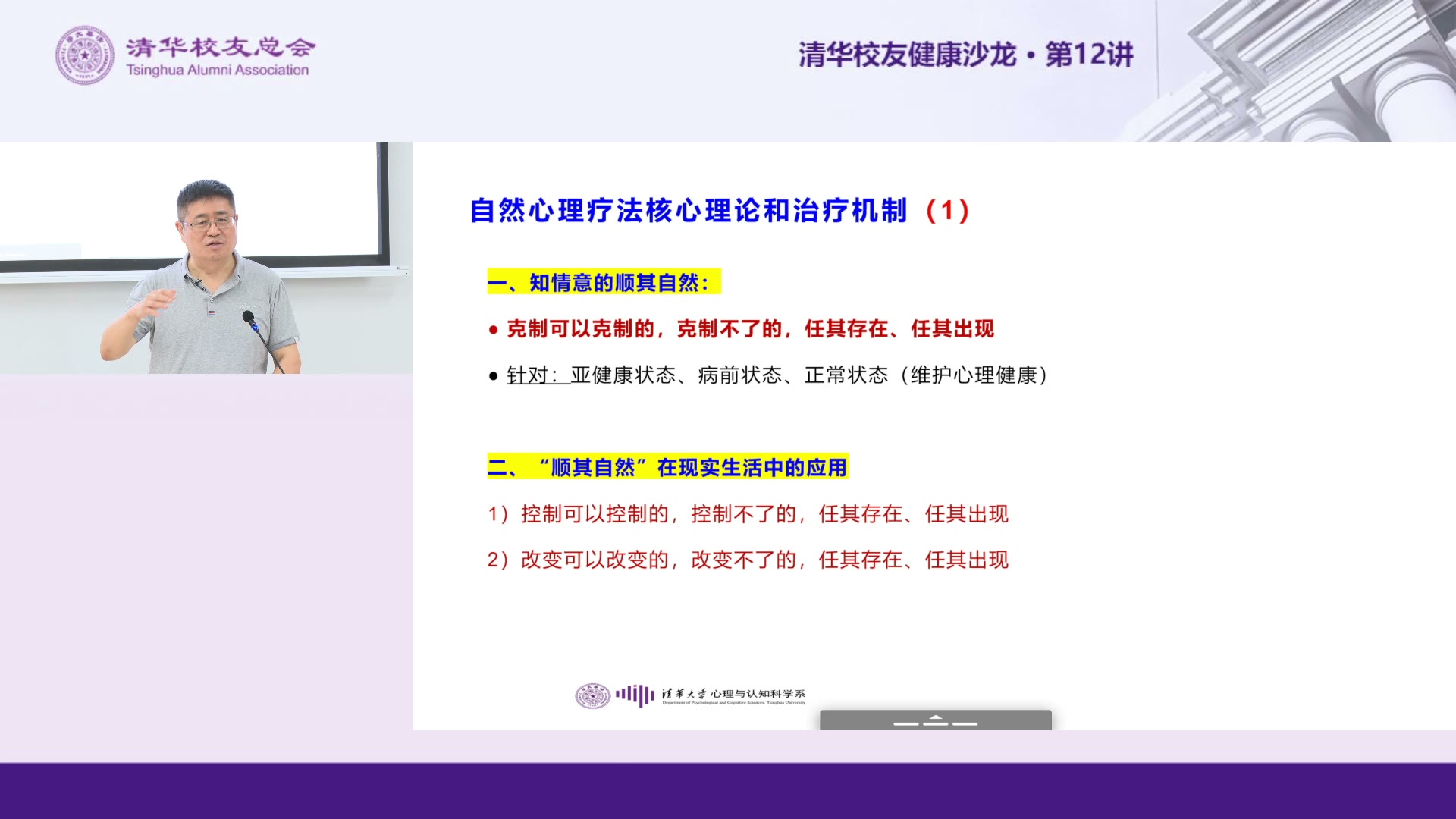
1.1 Control What You Can; Let Be What You Cannot

This is the most foundational philosophical idea of Natural Psychotherapy.

Two Steps: 1. ๐Ÿ” Identify โ€” distinguish what is controllable from what is uncontrollable 2. โœ‹ Act โ€” focus on the controllable part, allow the uncontrollable part to exist

Application Case โ‘ : Marriage โ€” Husband Who Doesn’t Like to Talk

Scenario: The wife talks a lot (7,000โ€“20,000 words daily), the husband is a man of few words (about 2,000 words daily).

Natural Psychotherapy Analysis:

Uncontrollable (Let It Be) Controllable (Focus Action)
๐Ÿšซ The husband’s innate quiet nature โœ… Take the initiative to share one light, easy topic
๐Ÿšซ Whether the husband is tired that day โœ… Bring him some fruit, pour him a glass of water
๐Ÿšซ The husband’s need for alone time to recharge โœ… Watch TV with him (quiet companionship is enough)
๐Ÿšซ Forcing him to become talkative โœ… Vent to a close friend / join activities

Result: The wife stops interrogating and blaming. The husband feels no pressure, so he relaxes and becomes more willing to communicate.

๐Ÿ’ก Core takeaway: Accept the other person as they are. Control your own emotions first, so you can free your hands to work on the changeable parts of the relationship.

Application Case โ‘ก: Child Scored 51 on a Test

โŒ Wrong reaction: Scolding, punishing, panicking, demanding “How could you score this?” โœ… Natural Psychotherapy approach: - The score is fixed โ†’ uncontrollable, accept it - Help the child analyze mistakes โ†’ controllable, take action - Create an improvement plan โ†’ controllable, take action


๐Ÿ›๏ธ Core Principle 2: The 24-Character Formula (The Core Treatment Logic)

This is the soul of Natural Psychotherapy and the most essential difference from Japan’s Morita Therapy.

The Complete 24 Characters

Stage Formula Meaning
๐Ÿฅ‡ Endure the pain, do what you must Passively endure symptoms while doing what you need to do
๐Ÿฅˆ Accept the pain, refrain from what you must not Actively accept symptoms; control pathological and avoidance behaviors
๐Ÿฅ‰ Seek the pain, do what you fear Actively seek out feared situations and face them head-on

Simplified Version: The 14-Character Mantra

๐Ÿ™ˆ Don’t attend ยท ๐Ÿฆ Don’t fear ยท โœ‹ Don’t resist ยท ๐Ÿƒ Don’t escape ยท ๐Ÿ’ช Act positively

Principle Meaning
๐Ÿ™ˆ Don’t attend Don’t focus on symptoms, don’t get entangled in thinking loops
๐Ÿฆ Don’t fear Don’t be afraid of the feelings that symptoms bring
โœ‹ Don’t resist Don’t fight symptoms; allow them to exist
๐Ÿƒ Don’t escape Don’t avoid situations that trigger fear
๐Ÿ’ช Act positively Do what needs to be done, symptoms and all

The Progressive Relationship of the Three Stages

Stage One: Endure the pain, do what you must - OCD patients: Endure recurring obsessive thoughts while going to work/school - Anxiety patients: Endure heart palpitations and unease while socializing/attending meetings - Insomnia patients: Endure not sleeping, yet still function normally during the day

Stage Two: Accept the pain, refrain from what you must not - “Refrain from what you must not” has two aspects: 1. ๐Ÿšซ Control pathological behaviors โ€” e.g., compulsive hand-washers control repeated washing 2. ๐Ÿšซ Control avoidance behaviors โ€” e.g., social phobics control avoidance

Stage Three: Seek the pain, do what you fear ๐ŸŽฏ - This is what makes Natural Psychotherapy unique โ€” instead of passively enduring, you actively seek out situations that frighten you - Whatever you fear, go and do it - Completely break the vicious cycle of fear

Differential Guidance for Different Disorders

Although the 24-character formula applies broadly, specific guidance varies by disorder:

Disorder Focus
๐Ÿ”„ OCD Curb rumination, control compulsive behaviors
๐Ÿ˜ฐ Anxiety disorders Endure anxiety, don’t avoid trigger situations
๐ŸŒ™ Insomnia Don’t fight insomnia, accept not being able to sleep
๐Ÿ˜จ Phobias Do what you fear โ€” face the object of fear directly
๐Ÿ“ฑ Internet addiction Control behavior, endure withdrawal discomfort

๐Ÿ’ช Core Principle 3: The Three Functions of Action

Why emphasize “act positively”? Action isn’t just moving around aimlessly โ€” it serves three core functions:

Function โ‘ : Improves Negative Emotions ๐Ÿ˜Š

  • When people are anxious or depressed, the more they lie still, the worse their mood becomes
  • Taking action โ†’ anxiety lessens, mood improves
  • This is the simplest and most effective way to regulate emotions

Function โ‘ก: Adjusts Thinking ๐Ÿง 

  • Obsessive thoughts / anxious thinking = cognitive distortions
  • It’s very hard to correct these through subjective willpower alone
  • Only action can “pull people out” of this thought state
  • Action can genuinely shift the trajectory of cognition

Function โ‘ข: Improves Character ๐ŸŒฑ

“Old habits die hard โ€” but while character can’t be fundamentally changed, it can be improved.

  • Bed-rest phase: Build psychological resilience and flexibility
  • Heavy-labor phase: Push past fatigue, enhance self-discipline and perseverance
  • People with the “three hearts” (strong pride, strong competitiveness, strong vanity) improve character flaws through action

โš ๏ธ Important Reminder: The Goal of Action Is NOT to Eliminate Symptoms

Many patients ask: “I run every day, do yoga, go to the gym โ€” I’ve kept at it for over a year. Why are my symptoms still here?”

Prof. Zhang’s Answer:

“Action itself is not about eliminating your symptoms โ€” it’s about living life with your symptoms. The symptoms may still be there, but your way of coping has changed.


๐Ÿ”„ Core Principle 4: Cutting Mental Interaction

What Is Mental Interaction?

A psychological concept: The more you focus on / reject a certain feeling, the stronger that feeling becomes, forming a vicious cycle.

A Typical Spiral: 1. Anxiety arises 2. You think “I don’t want to be anxious” 3. The more you try to eliminate it, the stronger the anxiety grows 4. You try even harder to eliminate it… 5. Spiral escalates to a severe state ๐Ÿ”„

Natural Psychotherapy’s Counter-Strategy

Use the “Four Don’ts” to cut off the vicious cycle:

A symptom appears (anxiety / obsessive thoughts / insomnia)
    โ†“
๐Ÿ™ˆ Don't attend (don't focus on it)
๐Ÿฆ Don't fear (don't be afraid of it)
โœ‹ Don't resist (don't fight it)
๐Ÿƒ Don't escape (don't avoid it)
    โ†“
๐Ÿ’ช Act positively (go do what you need to do)
    โ†“
Mental interaction is cut โœ“
Symptoms naturally and gradually fade

๐Ÿก Real-Life Applications

Application โ‘ : Smoking Addiction ๐Ÿšฌ

“Someone once told me: ‘Quitting smoking is the easiest thing in the world โ€” I’ve quit a hundred times.’” ๐Ÿ˜‚

Key Insight: - Addictive behaviors (smoking) fall under Yi (behavior) โ€” they can be controlled - But if a person gets sick and the doctor says “quit smoking or you’ll die” โ€” they will quit - This shows willpower can work; it just needs enough motivation

Applied to Psychotherapy: - Compulsive behaviors (repeated hand-washing), internet addiction, substance addiction โ€” these are all behavioral issues - Behavior can be controlled! - If Natural Psychotherapy can treat OCD โ†’ in theory it can treat all kinds of addiction

Application โ‘ก: “Go with Nature” in Interpersonal Relationships ๐Ÿ‘จโ€๐Ÿ‘ฉโ€๐Ÿ‘งโ€๐Ÿ‘ฆ

The principle for resolving all relationship conflicts:

Both sides must remain emotionally balanced; neither should be in a twisted, conflicted state.

Applicable scenarios: - Parent-child relationships: How to communicate when a child enters adolescence - Marital relationships: How to handle disagreements - Mother-in-law/daughter-in-law relationships: Called “the Gordian knot of Chinese relationships” - Workplace relationships: Conflict at work


๐Ÿค Natural Psychotherapy’s Relationship with Other Schools

Inclusion and Integration ๐Ÿ‘

“When applying Natural Psychotherapy, as long as your underlying logic is the 24-character formula, you can graft in the best parts of any other psychotherapeutic school or method.”

  • Does not reject CBT, psychoanalysis, humanistic therapy, etc.
  • Does not engage in inter-school attacks
  • Encourages innovation: if you use it well, you can even found your own school

“Demystification” โ€” Psychotherapy Is Not Inaccessible

“Many therapists have spent hundreds of thousands learning various schools โ€” learn it in a flash, fail in practice.”

How Natural Psychotherapy is different: - โŒ Traditional: Learn theory โ†’ supervision โ†’ practice (long cycle, high barrier to entry) - โœ… Natural Psychotherapy: Practice โ†’ summarize โ†’ guide further practice (great truth is simple)


๐ŸŽ“ Lecture Summary: Four Things You Need to Remember

# Core Principle In One Sentence
โ‘  ๐ŸŒŠ Go with Nature Control what you can; let be what you cannot
โ‘ก ๐Ÿ›๏ธ 24-Character Formula Endure โ†’ Accept โ†’ Seek; actively face suffering
โ‘ข ๐Ÿ’ช Three Functions of Action Improve emotions, adjust thinking, improve character
โ‘ฃ ๐Ÿ”„ Cut Mental Interaction Don’t attend, don’t fear, don’t resist, don’t escape

The 14-Character Mantra (Just Remember This!)

๐Ÿ™ˆ Don’t attend ยท ๐Ÿฆ Don’t fear ยท โœ‹ Don’t resist ยท ๐Ÿƒ Don’t escape ยท ๐Ÿ’ช Act positively


๐Ÿ’ก Key Takeaways from This Lecture: 1. Mental activity is divided into Zhi (cognition), Qing (emotion), and Yi (behavior) โ€” only Yi (behavior) is controllable 2. Going with nature = distinguish controllable from uncontrollable, focus on the controllable 3. The 24-character formula: Endure pain โ†’ Accept pain โ†’ Seek pain, progressive stages 4. Action has three functions, but its purpose is not to eliminate symptoms โ€” it’s to live life with symptoms 5. Cut the vicious cycle of mental interaction, and symptoms naturally fade 6. Natural Psychotherapy is open and inclusive โ€” it can integrate the best of other therapies


๐Ÿ“ Notes compiled by: Hu Xiaozhong using AI | June 2026

Lecture 4

๐Ÿ”„ Theory Review & New Applications

๐Ÿ“… 2026.6.12โฑ 2h0min
Content: Review of 4 core theories ยท Dr. Xu Haijun case study ยท Bed rest โ€” 70% symptom reduction in 10 days ยท "True Acceptance Is Non-Acceptance" ยท Psychological vaccine concept ยท Group therapy breakthrough (40-50 patients)

๐Ÿ”„ Natural Psychotherapy Lecture 4: Theory Review, Case Deepening & New Applications

Lecturer: Prof. Zhang Xiangyang (Department of Psychological and Cognitive Sciences, Tsinghua University) Lecture Topic: Mental Health Popular Science Lecture โ€” Session 4 Date: June 12, 2026 Duration: ~2 hours


โš ๏ธ This lecture primarily serves as a review of the core theories from the first three sessions, while incorporating a large number of latest cases and extensions of new concepts. If you haven’t watched the first three lectures, it’s recommended to review the notes for Lectures 1, 2, and 3 first.


๐Ÿ”™ Opening: Latest Success Case โ€” Dr. Xu Haijun

Xu Haijun, Director of the Psychology Department at the Second Hospital of Shanxi Medical University. Attended a 2-day Natural Therapy training course in Hefei six months ago.

WeChat message sent to Prof. Zhang this morning: - Before: never dared to take on OCD and PTSD cases - Now: takes on the most complex OCD and PTSD cases in the entire hospital - Feeling: “Governing a big country is like cooking a small fish” ๐Ÿณ - Full of confidence, with more and more experience accumulating

Just two days of training + six months of practice โ€” someone who never dared to take on OCD patients became a fully confident professional therapist.

Tianjin Base Case

Yesterday, all 6 OCD patients at the Tianjin base achieved good results. One severe OCD patient: - Had tried multiple treatments with no effect, heavily medicated - After the bed rest period (~10 days) - OCD symptoms reduced by 70%! - Has stopped all medication ๐Ÿ’ŠโŒ - The patient’s first words to their mother: “Mom, I’m much better now. I’m healed.” ๐Ÿ˜ญ


๐Ÿ“ Quick Review of the Four Core Theories

Theory 1: Let It Be (Go with the Flow / Shun Qi Zi Ran)

Control what can be controlled; let what cannot be controlled be, let it arise. Change what can be changed; what cannot be changed, please let it be, let it arise.

This is the application of the Cognition-Emotion-Will theory:

Dimension Can It Be Controlled? Attitude
๐Ÿง  Cognition (thoughts/mind) โŒ No Let it be
โค๏ธ Emotion (feelings) โŒ No Let it be
๐Ÿƒ Will (behavior) โœ… Yes Focus on action

Theory 2: The 24-Character Guideline

Stage Guideline
๐Ÿฅ‡ Endure the pain, do what you ought to do
๐Ÿฅˆ Accept the pain, refrain from what you ought not to do
๐Ÿฅ‰ Seek the pain, do what you fear to do

Theory 3: Primary Thinking vs. Secondary Thinking

  • Primary thinking: The initial thought/notion that appears (uncontrollable)
  • Secondary thinking: The resistance/opposition/association triggered by the primary thought (controllable)
  • Key: Restrain secondary thinking to break the vicious cycle

Theory 4: Dual Suffering (The Two Arrows Effect)

  • First layer of suffering: Primary anxiety, fear, discomfort
  • Second layer of suffering: Greater suffering arising from trying to escape the first layer
  • Treatment strategy: Accept the primary suffering โ†’ the second layer of suffering naturally diminishes

๐Ÿงง New Concept: Zheng Shou Bu Shou, Bu Zhi Er Zhi (True Acceptance Is Non-Acceptance; Non-Treatment Is True Treatment)

ๆญฃๅ—ไธๅ—๏ผŒไธๆฒป่€Œๆฒปใ€‚ True acceptance is non-acceptance; non-treatment is true treatment.

This phrase embodies the essence of Eastern wisdom in Natural Therapy:

Concept Meaning
๐ŸŽฏ True acceptance is non-acceptance When you directly accept something, it’s as if you haven’t accepted it (it no longer troubles you)
๐Ÿฉบ Non-treatment is true treatment Seemingly doing no treatment (having you accept your symptoms), yet the symptoms actually disappear

This is the fundamental difference between Eastern wisdom and Western therapy:

Comparison Western Therapy Natural Therapy (Eastern Wisdom)
Attitude toward symptoms โŒ Eliminate, remove, fight โœ… Accept, merge with
Method Medication, physical regulation, exposure therapy True acceptance is non-acceptance; non-treatment is true treatment
Philosophical foundation Struggle, conquest ๐Ÿ”ฎ Doctrine of the Mean, acceptance

Prof. Zhang says: “I can’t beat you โ€” so let me join you, how about that?” ๐Ÿ˜„


๐ŸŽฏ The Core Eight Characters of Natural Therapy

Accept the pain, take positive action ๆŽฅ็บณ็—›่‹ฆ๏ผŒ็งฏๆž่กŒๅŠจ

First Half Second Half
๐Ÿ™ Accept the pain ๐Ÿ’ช Take positive action
Aligned with Buddhist “turning suffering into the path” Completely consistent with Wang Yangming’s “unity of knowledge and action”
No rejection, no resistance Do what needs to be done while carrying the pain

These eight characters are the most distilled summary of the entire Natural Therapy system. From 24 characters โ†’ 14 characters โ†’ 8 characters, it keeps getting simpler.


๐Ÿง˜ The Three-Step Method (Treatment Operation Guide)

Prof. Zhang presented a “three-step method” operational process for treating psychological disorders:

Step Name Description
โ‘  ๐Ÿ” Awareness (detection) Help patients become aware of their thought patterns and emotional reactions
โ‘ก ๐Ÿ‹๏ธ Training Build psychological resilience through bed rest, light physical labor, and heavy physical labor
โ‘ข ๐Ÿš€ Action Take positive action, live with symptoms

The three-step method is fully aligned with the two major restraints in “refraining from what ought not to be done”: 1. Let obsessive thoughts arise, restrain compulsive behaviors 2. Let primary thoughts arise, restrain secondary thinking


๐Ÿงช The 14-Character Guideline Applied to Adolescent Prevention

Prof. Zhang’s team is advancing Natural Meditation for preventing psychological issues in adolescents:

Psychological Vaccine ๐Ÿฉน

Concept: Give adolescents a “psychological vaccine” โ€” prevention before problems arise.

Method of operation: - Spend 10โ€“14 minutes per day - Combine the 14-character guideline + meditation (four scenes: prairie๐ŸŒฟ, seaside๐ŸŒŠ, forest๐ŸŒฒ, breath awareness) - Persist for 28 days - Paired with guiding instructions: regarding your anxiety, depression, conflicts with classmates, criticism from teachers โ€”

Don’t rationalize, don’t fear, don’t resist, don’t avoid โ€” take positive action

Preliminary results โœ…: - Phase 1: 9 schools - Phase 2: 22 schools - Can effectively reduce adolescents’ anxiety, depression, and suicidal ideation - Phase 3 plan: 50 schools


๐Ÿฅ Three Treatment Modalities

Modality Description
๐Ÿช Outpatient Regular one-on-one counseling/treatment
๐Ÿ’ป Online Remote treatment (suitable for patients unable to attend in person)
๐Ÿจ Inpatient Tianjin Psychological Empowerment Base, includes bed rest + light/heavy labor periods

Major Breakthrough in Group Therapy

Treating 40โ€“50 OCD patients in one session โ€” this is a world-class breakthrough!

Bottleneck: Not the lecture itself (100 listeners is the same as 50), but the shortage of group leaders: - Groups of 10, with 2 group leaders each - 50 patients need 10 group leaders - 100 patients need 20 group leaders

Hefei Phase 3 Group Therapy Case: - Dr. Hu Ranran (psychiatrist at Hefei Fourth Hospital, Ph.D.) - Initially skeptical (even disbelieving) โ€” how could OCD be treated in a group setting? - After leading the 8-week course: “I am so happy now!” All 3 patients under his care fully recovered ๐ŸŽ‰


๐Ÿ“š New Quotes from This Lecture

“True acceptance is non-acceptance; non-treatment is true treatment.”

“Accept the pain, take positive action.” โ€” The core eight characters of Natural Therapy

“Governing a big country is like cooking a small fish.” โ€” Dr. Xu Haijun’s feeling after completing the Natural Therapy training

“Pain has energy; pain has function. Every person living in this world will encounter pain sooner or later โ€” so don’t try to eliminate it, face it and accept it.”

“Psychological vaccine โ€” give adolescents their psychological preventive shot early.”

“Everything has its rules and patterns. As long as you grasp those patterns and rules, any problem can be solved.”

“Our therapy is like the game of Go โ€” the rules are extremely simple, yet the subtleties are infinite and the variations are endless.”


๐Ÿ”— Relationship with the First Three Lectures

This Lecture’s Content Corresponding Previous Lectures
๐Ÿ”™ Review of the four theories Lecture 3 (Core concepts)
๐ŸŒŸ Dr. Xu Haijun case Lecture 2 (Case of rapid therapy mastery)
๐Ÿฉน Psychological vaccine Lecture 2 (Natural Meditation project)
๐Ÿฅ Group therapy breakthrough Lecture 1 (One-to-many model)
๐Ÿ”ฎ Eastern wisdom vs. Western therapy Lecture 2 (Comparison of therapy origins)

๐Ÿ’ก Key Takeaways from This Lecture: 1. The core of Natural Therapy = “Accept the pain, take positive action” โ€” eight characters 2. “True acceptance is non-acceptance; non-treatment is true treatment” is the best embodiment of Eastern wisdom 3. Three-step method: Awareness โ†’ Training โ†’ Action 4. The Psychological Vaccine project is progressing, targeting 50 schools 5. Group therapy for OCD (40โ€“50 patients per session) has been validated with astonishing results 6. The therapy is like Go โ€” simple rules, yet infinitely varied in application


๐Ÿ“ Notes compiled by: Hu Xiaozhong using AI | June 2026

๐Ÿง˜ Natural Meditation

10 minutes daily, 28 days. Combined with the 14-character mantra: "Don't engage, don't fear, don't resist, don't avoid โ€” take positive action."

๐ŸŒŠ Ocean Meditation: Combine with the 14-character mantra. Imagine yourself by the sea, listen to the waves, silently recite: "Don't engage, don't fear, don't resist, don't avoid โ€” take positive action."